Google’s Gemini 3 Arrives — What It Means for the Future of Search, AI, and the Big Tech Battlefield ?

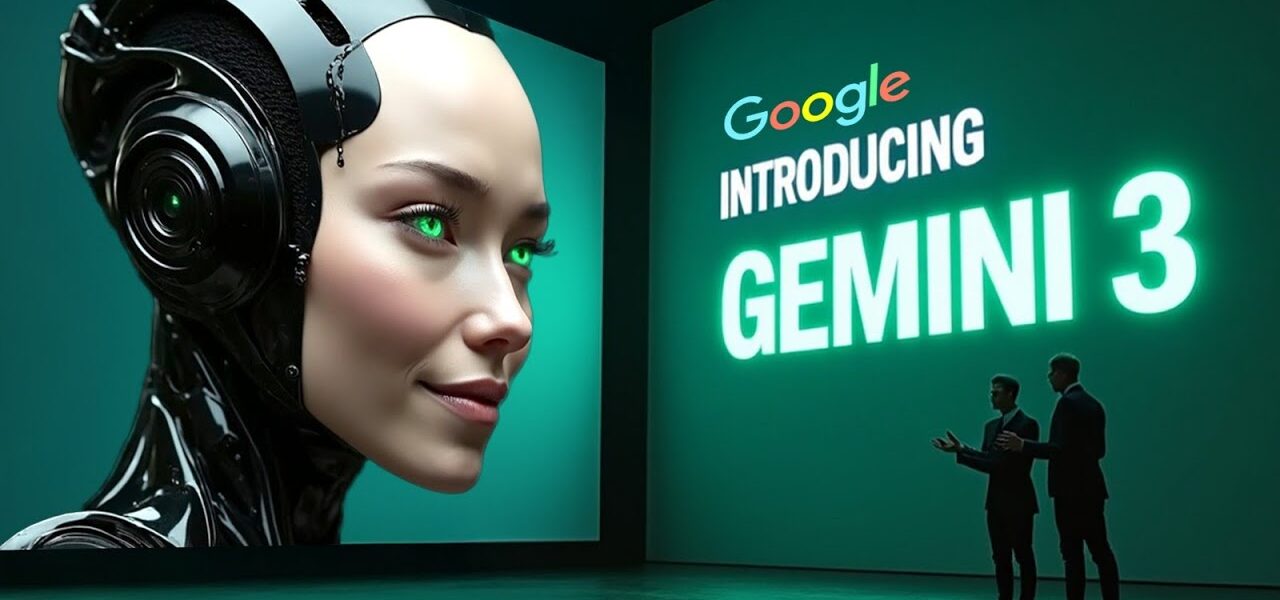
On November 18, 2025, Google unleashed a significant leap in its artificial intelligence journey with the launch of Gemini 3, its most powerful and intelligent model yet. This move marks more than just a product update: it’s a bold bet by Google to challenge the dominance of OpenAI’s ChatGPT and reimagine how we interact with information, search, and even creativity.
With Gemini 3 integrated on day one into Google Search, the company is leveraging its full-stack advantage — from infrastructure and research to consumer apps — to accelerate its AI ambitions. But amid the fanfare, CEO Sundar Pichai issued a sobering note on rising irrationality in the AI market.
Simultaneously, a titanic alliance formed between Microsoft, Nvidia, and Anthropic, underlining how the AI race is now about more than model innovation — it’s about infrastructure, compute power, and strategic partnerships.
In this blog, we’ll dive deep into what Gemini 3 brings, why it matters, and how the broader industry is shifting. Let’s explore.
What Is Gemini 3 — And Why It’s a Big Deal
1. A Quantum Leap in Intelligence
- Google describes Gemini 3 as its most intelligent model to date, built for “state-of-the-art reasoning, deep multimodal understanding, and agentic capabilities.” blog.google+2blog.google+2
- It outperforms its predecessor, Gemini 2.5 Pro, across major AI benchmarks. blog.google+1
- On the reasoning front, Google claims Gemini 3 “grasps unprecedented depth and nuance,” meaning it’s better at understanding complex intent behind user queries. blog.google+1
2. Integration Directly Into Google Search
- For the first time, a Gemini model is embedded into Google Search right from day one. blog.google
- Users with Google AI Pro and Ultra plans can access Gemini 3 Pro by selecting the “Thinking” model in the AI Mode of Search. blog.google
- Gemini 3 enhances Google’s “query fan-out” technique: it can split a complex question into sub-questions, run multiple searches, and then synthesize better, more relevant answers. blog.google
- It also powers generative UI: based on your question, Gemini 3 can render dynamic layouts — images, tables, simulation tools — instead of just plain text. blog.google
3. Agentic Coding and Developer Power
- Google is launching Google Antigravity, a brand-new “agent-first” development platform where Gemini 3-powered agents can access the code editor, terminal, and even the browser. blog.google
- These AI agents can plan, execute, and validate multi-step tasks autonomously, such as building a web app, debugging, or even more complex workflows. blog.google
- Gemini 3’s coding benchmark scores are very strong: it performs well on tasks like planning and tool use, as well as reasoning over longer horizons. blog.google
4. Safety, Security, and Responsible AI
- Google claims Gemini 3 is its most secure model yet: it has been tested heavily for prompt injection attacks, misuse risks, and sycophancy. blog.google
- It has undergone rigorous evaluations, including by external experts, as part of Google’s “Frontier Safety Framework.” blog.google
- There’s also a Deep Think mode (coming soon), which is being more carefully evaluated before wider distribution. blog.google
Why Gemini 3 Is a Threat to ChatGPT and OpenAI
- Distribution Edge
Google doesn’t just build models — it owns the pipeline: from research to hardware (TPUs), to cloud infrastructure, to the Search app used by billions. - Massive Reach
By embedding Gemini 3 into Search, Google ensures it reaches users without asking them to open a different app. This could undercut OpenAI’s standalone model distribution. - Aggressive Benchmark Performance
Gemini 3’s performance on reasoning, coding, and multimodal tasks makes it competitive with frontier models. - Full-Stack Advantage
Google’s strength in infrastructure (compute, data centers) gives it a cost and scale advantage.
Because of all this, many analysts view Gemini 3’s launch as Google’s most aggressive move yet to challenge OpenAI.
But It’s Not All Sunshine — Pichai’s Warning & Industry Risks
Caution from the Top: Sundar Pichai has publicly warned about “irrationality” in the current AI market. Given the hype, he suggested that even Google isn’t safe if a bubble bursts.
Hallucination Risks: While Google has improved Gemini’s factual accuracy, earlier tools like AI Overviews have had issues.
User Trust: As reasoning models become more powerful, ensuring that they remain transparent and reliable is a key challenge.
Regulatory Scrutiny: With AI models tightly integrated into essential tools like search, questions about accountability, data privacy, and misinformation are likely to intensify.
The Bigger Picture: Microsoft + Nvidia + Anthropic Tie-Up
While Google is betting hard on Gemini 3, its rivals are also making bold moves:
- Microsoft and Nvidia are jointly investing up to $15 billion in Anthropic, the company behind Claude AI.
- As part of the deal, Anthropic has committed to buying $30 billion worth of Azure compute capacity.
- There is a deep technology collaboration between Nvidia and Anthropic: they will optimize Claude models for existing and future Nvidia architectures (Grace Blackwell, Vera Rubin, etc.).
- Microsoft will make Claude models available in its Foundry platform and integrate them into its Copilot suite (GitHub Copilot, Microsoft 365 Copilot).
Why this matters:
- This deal diversifies Microsoft’s AI strategy, reducing reliance on OpenAI.
- Nvidia secures long-term demand for its cutting-edge AI hardware.
- Claude becomes more widely available across cloud platforms, raising the bar for competition with Google’s Gemini and OpenAI’s models.
What This Means for Users and Developers
- For users: Expect more powerful and context-aware answers in Google Search. You might get interactive explanations, simulations, or tools directly within the search results.
- For developers: Google Antigravity could change how you build software—AI agents may take a more active role in coding and executing tasks.
- For enterprises: More choice in AI models (Claude, Gemini) + deeper infrastructure partnerships means flexibility and stronger bargaining power.
- For the ecosystem: With major players like Microsoft, Nvidia, and Google making huge bets, AI is likely to become even more central to cloud strategy, app experiences, and future product innovation.
Risks & Ethical Considerations
- Misinformation & Hallucination: As models become more powerful, wrong or misleading answers can become more persuasive.
- Overdependence: Businesses and users may rely too heavily on AI-driven decision-making without understanding limitations.
- Compute & Energy Costs: The huge infrastructure commitments (like Anthropic’s gigawatt-level compute) raise questions about energy consumption and sustainability.
- Power Dynamics: When a few companies control both models and compute, there’s a risk of concentration of power, potentially sidelining smaller players or open-source initiatives.
Conclusion
The Gemini 3 launch is a watershed moment for Google — not just because of its technical advances, but because of its integration into Search, which could redefine how people use AI daily. At the same time, the Microsoft-Nvidia-Anthropic alliance underscores that frontier-model development is no longer just about who builds smarter AI; it’s about who controls the compute, the infrastructure, and the ecosystem.
Sundar Pichai’s caution about irrationality in the AI market is a timely reminder: even as innovation accelerates, the stakes are high. For users, developers, and businesses, the road ahead is full of opportunity — but also risk.
What do you think? Is Gemini 3 a game-changer in AI, or is this another hype cycle? Do you see the Microsoft–Nvidia–Anthropic deal as a smarter bet than Google’s full-stack play?